
The Emotional Weight of Holding Everything Inside
Creative Arts Connect · Jul 7, 2026 · 4 min read


Creative Arts Connect
There are moments when people carry far more than others can see.
They continue showing up for work, caring for family members, responding to messages, meeting responsibilities and moving through daily life. From the outside, everything may appear manageable. Yet internally, emotions, worries, disappointments, grief, stress or unanswered questions continue to accumulate.
Many people become skilled at carrying these experiences quietly.
Over time, however, holding everything inside can become emotionally and physically exhausting.
While keeping difficult feelings contained may sometimes feel protective, it can also create a growing sense of pressure, isolation and overwhelm.
Why Do We Hold Things In?
There are many reasons why people choose not to express what they are experiencing.
Some have learned from an early age that emotions should be hidden.
Others may worry about burdening those around them. Some fear judgment, rejection, conflict or vulnerability. Others simply struggle to find words for experiences that feel complex or confusing.
Messages such as:
"Stay strong."
"Don't make a fuss."
"Other people have it worse."
"Just move on."
can teach people to minimise or suppress their emotional experiences.
Over time, emotional withholding can become habitual. Instead of asking for support or expressing feelings, individuals learn to carry them privately.
The Cost of Emotional Containment
There is a difference between choosing not to share something immediately and carrying everything alone indefinitely.
When emotions remain unacknowledged for long periods, they do not necessarily disappear.
Instead, they often continue to influence thoughts, behaviours, relationships and physical well-being.
This may look like:
People sometimes describe this experience as feeling "heavy."
The heaviness often reflects the effort required to continually contain experiences that have not yet found an outlet.
When Words Feel Insufficient
One of the challenges of emotional expression is that not all experiences fit neatly into language.
Some emotions feel layered or contradictory.
A person may feel grief and relief at the same time. They may feel anger alongside sadness. They may carry experiences that exist more as sensations, memories, images or fragments rather than clear narratives.
In these situations, being told to "talk about it" may not always feel helpful.
It is not necessarily that the person is unwilling to communicate. Sometimes the experience itself has not yet taken a form that can easily be spoken.
This is one reason why expressive approaches can be valuable.
The Importance of Externalising Experience
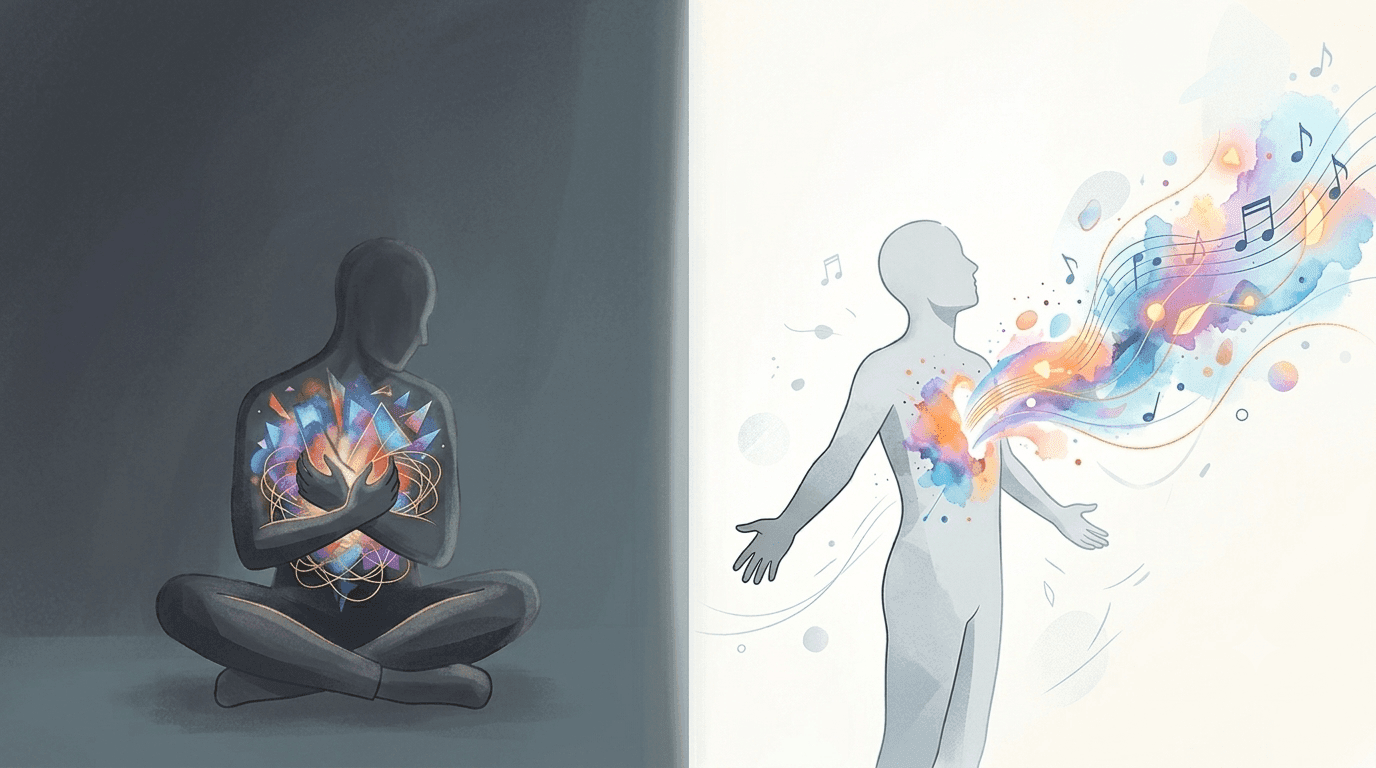
Within expressive arts therapies, there is often an emphasis on externalising internal experiences.
Externalising means bringing something from the internal world into a visible, tangible or observable form.
This might occur through:
Drawing
Painting
Movement
Music
Drama
The purpose is not artistic achievement.
The purpose is to create space between the individual and the experience.
When emotions remain entirely internal, they can feel overwhelming and difficult to understand. When they are expressed externally, they become something that can be observed, reflected upon and related to differently.
The experience is no longer carried solely inside.
Why Expression Can Feel Relieving
Creative expression does not solve problems automatically.
However, it can reduce the pressure of holding everything internally.
Research across psychology and expressive therapies suggests that emotional processing is often supported when experiences are acknowledged rather than continually suppressed.
Expression can help individuals:
Importantly, expression does not require immediate insight or resolution.
Sometimes the value lies simply in allowing something to exist outside oneself.
The Role of Witnessing
Many people assume emotional healing requires finding the perfect solution.
In reality, there are times when what is needed first is witnessing.
Witnessing involves allowing an experience to be acknowledged without rushing to fix, analyse or dismiss it.
This can occur within relationships, communities and therapeutic settings.
It can also occur through creative processes.
An image, movement or piece of creative work can serve as a witness to what has been carried internally. It gives shape to an experience that may previously have felt invisible.
Rather than asking, "How do I get rid of this feeling?" the focus becomes, "Can I allow this experience to be seen?"
This shift can create space for greater understanding and self-compassion.
A Closing Reflection
Holding everything inside often begins as an attempt to cope.
Yet carrying emotions alone for extended periods can become a burden in itself.
Not every feeling needs to be shared immediately. Not every experience needs to be explained in perfect detail. However, emotional experiences generally benefit from some form of acknowledgement, expression or connection.
Whether through conversation, creativity, movement, reflection or therapeutic support, finding safe ways to externalise what we carry can reduce the weight of holding it alone.
Sometimes healing does not begin with solving a problem.
Sometimes it begins with allowing what has been hidden to take up a little space outside of ourselves.
Ready to Find the Right Therapist?
Our 3-minute matching quiz connects you with a vetted creative arts therapist who fits your needs.
Find Your Match →